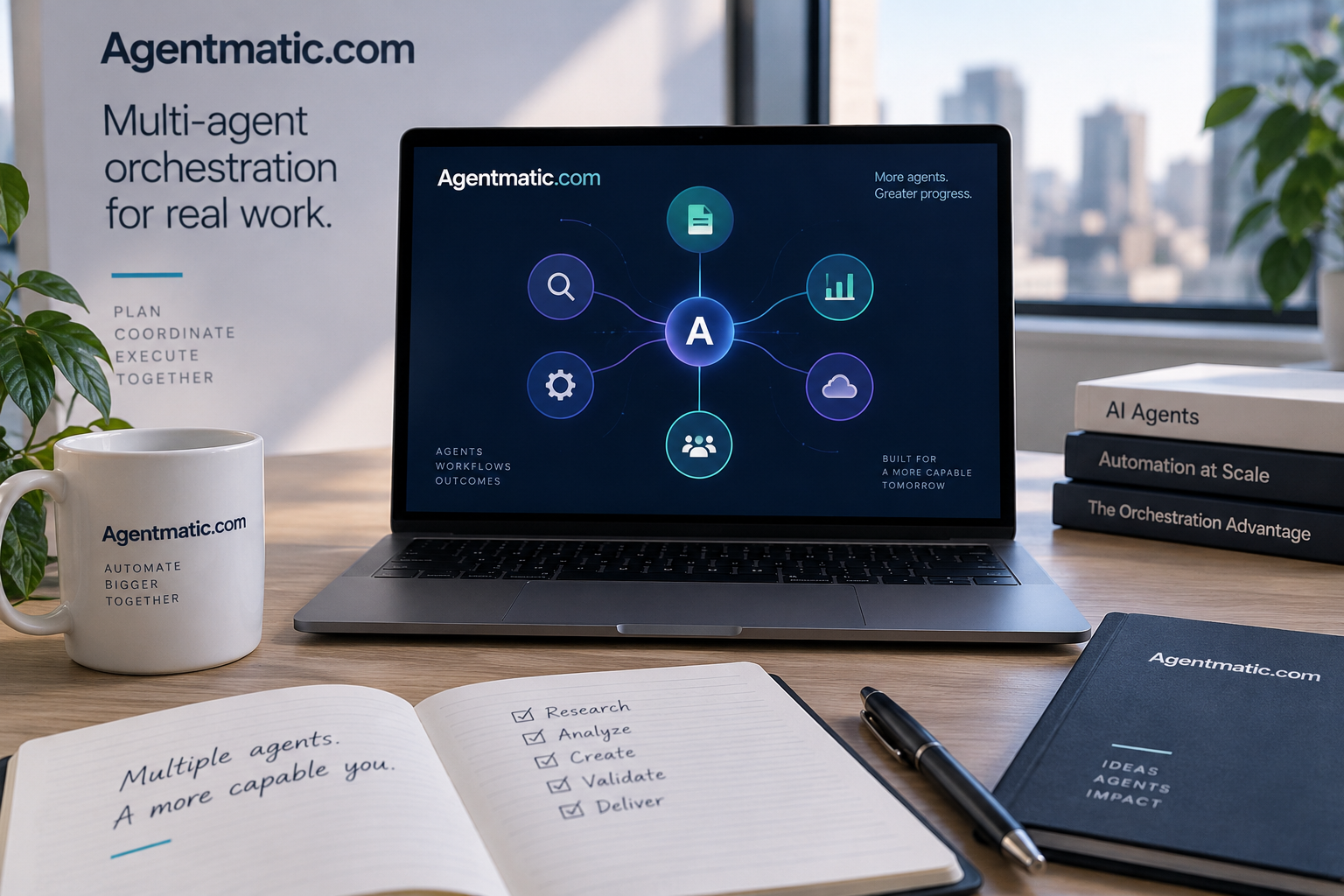
A platform for multiple agents needs to explain the work between them. Which component owns the request? What information moves to the next step? Who can approve an external action? Agentmatic.com could be a useful identity for a product built around those questions, especially when the customer is responsible for operating a workflow rather than watching a demonstration.
This is an illustrative platform direction. It describes possible architecture and positioning, with no claim about a deployed system, throughput, or number of supported agents. The right implementation would depend on the workflows and environments the buyer intends to serve.
Start with a team that already has coordination pain
The first customer could be a product engineering team that has separate components for retrieval, drafting, and review. Each component may work in isolation, but the overall job becomes hard to inspect when something fails. A platform has a clearer reason to exist when that team can point to a specific coordination problem.
Ask the team to trace one request across its current components. Identify where state is stored, how a failed step is retried, and how a person finds the original input. If the team can already solve the problem with a small, understandable workflow, a new platform may add more operating burden than value. That is worth learning before building an extensive control surface.
Define the layers in ordinary language
The first layer would describe the job. It needs an input, an expected output, a version, and a list of allowed steps. Keep this definition separate from a particular model response. A request should not gain new authority simply because a generated plan suggests another action.
The second layer would coordinate execution. It tracks the current step, the result of previous work, and the condition for moving forward. It should distinguish a completed step from a requested step. Those states may sound obvious, but they become important when a tool returns slowly or a worker restarts.
The third layer would govern access. A retrieval component may need read access to a document set while a publishing component needs a different, more restricted permission. The OWASP excessive agency guidance is a useful reference for keeping functionality, permissions, and autonomy proportionate to a task. A shared brand should not imply shared authority across every component.
The fourth layer would explain what happened. Operators need a trace with meaningful stages, relevant inputs, outputs, and decisions. A screen full of animated nodes is less useful than a clear answer to why the job stopped. Design the record around a support question someone will actually ask.
One possible workflow to demonstrate
Consider a team preparing an internal product update from approved source notes. One component locates relevant notes, another prepares a draft, and a third checks the draft against the source material. A human editor decides whether to publish. The platform’s role is to coordinate those stages and preserve their boundaries.
The draft should carry references to the notes used. The checker should record disputed statements rather than silently rewriting the whole update. If a source is missing, the job should return a visible exception. If the editor rejects publication, the system should retain that decision and the draft version to which it applied.
This example creates a useful demonstration without suggesting that every stage needs an independent agent. The product team could compare the design with a simpler pipeline. Extra components should earn their place through a practical need such as a separate permission scope or evaluation method, not through a desire to display a larger node diagram.
Treat interrupted work as a product feature
A serious evaluation should stop the workflow midway. Resume it, submit the same request again, and inspect what the operator sees. The platform should have a defined response to repeated inputs and partial results. Decisions about retries and duplicate actions belong in the architecture, especially when a downstream system can make lasting changes.
The exact mechanism is an engineering choice, but the user-facing requirement is clear: an operator should be able to tell what has happened and what would happen next. If restarting a job could repeat an external action, the interface needs to communicate that before the operator confirms the restart.
Find early users through technical evidence
A practical distribution path would be an open example repository or a detailed integration guide that solves one coordination problem. Show the inputs, state transitions, and failure behavior. Let a prospective user reproduce the example in a controlled environment. That gives a technical team something concrete to evaluate before discussing a broader deployment.
Documentation should identify assumptions and supported boundaries. If a connector only supports one kind of record, say so. If a review step pauses execution, explain how work resumes. Precise documentation can help the product reach the engineers who will later answer an internal buyer’s questions.
Decide how the platform earns its place
Before adding features, define the comparison. A customer may already use an existing workflow engine, a small script, or a manual review queue. The proposed platform needs a reason to be maintained alongside those tools. An evaluation could compare the effort required to diagnose a failed request or introduce a new approval step, with the same task used in each approach.
The NIST AI RMF can help frame broader evaluation and governance questions, but the product still needs evidence from its intended environment. Avoid claiming general reliability from a single example. The most persuasive early proof is a well-explained boundary and a test someone else can repeat.
Agentmatic.com could give this coordination layer a brand that is independent of a particular model provider. A plain category line might describe it as “orchestration and review for agent workflows.” Bring the architecture scope, customer type, and intended operating model when inquiring about the domain. Those details help distinguish a platform acquisition from a proposed operating partnership.