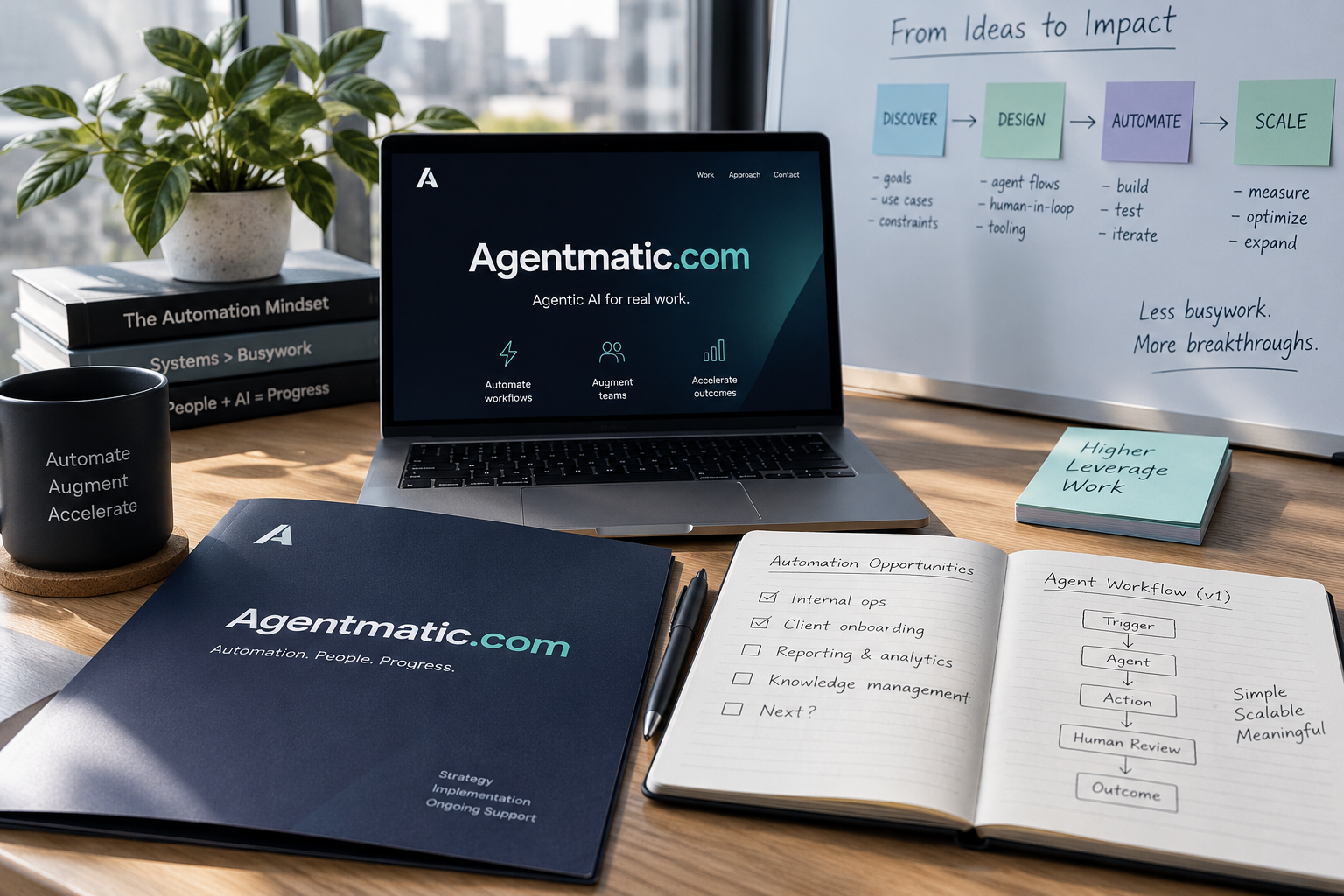
An automation consultancy earns its place by understanding the unglamorous parts of a business. A spreadsheet arrives late. Two systems disagree about a customer name. A task sits between departments because nobody owns the exception. Agentmatic.com could be the public identity for a consultancy that takes those problems seriously and makes its service easy to understand.
The following is an illustrative agency concept, not a current service offer under the domain. Its appeal would depend on the buyer’s actual expertise, delivery capacity, and customer relationships. A good domain can give that practice a coherent address; the practice still needs to do the work.
Choose a vertical before a long service menu
An early focus might be a small professional-services business with repeated client onboarding and reporting work. Narrow further if the team already knows a particular industry. Familiarity with a client’s vocabulary, approval habits, and document flow can be more useful in discovery than a long list of software integrations.
Describe the customer by the problem they can recognize. “Teams that re-enter approved project details into several systems” is a more useful opening than “companies seeking digital transformation.” It also helps qualify leads. A business that cannot name a recurring process may need discovery work before it needs an automation build.
Avoid presenting every task as an AI opportunity. Some work needs a better form, a clear owner, or a deterministic rule. A consultancy should be comfortable recommending that simpler answer. Its reputation will depend on the quality of the decision, including the decisions to leave a process manual.
Package the first engagement in three parts
Begin with a process review that produces a map of the current work. Show the trigger, systems touched, people involved, exceptions, and final output. Ask the client to confirm the map. This makes disagreements visible before implementation, especially when the official procedure differs from what staff actually do.
The second part is a bounded build. Select a workflow with a clear beginning and end, define the approved changes, and agree on the test examples. Keep changes outside that boundary on a separate list. That list can inform later work, but it should not silently enlarge the first engagement.
The third part is the handoff. Deliver operating instructions, access ownership, a recovery procedure, and a named maintenance contact. Decide how the client will know that a job failed. A build that only its original author can diagnose is difficult to hand over, even if the demonstration looked convincing.
An illustrative client journey
Consider a consultancy receiving an inquiry from a project-based business. Staff copy an approved project brief into a scheduling tool and then create a folder for supporting documents. The repeated typing is visible, but discovery reveals that the approved brief is sometimes changed after scheduling. The real issue includes version control and ownership.
The agency could propose a workflow that starts only when the brief reaches an agreed approved state. It creates a draft schedule entry, records which brief version it used, and sends uncertain dates to the project coordinator. Later changes become a review task rather than an automatic overwrite. The client can inspect the proposed behavior before granting write access.
The acceptance session should include an ordinary brief, an incomplete brief, a duplicate submission, and a revised brief. Staff should participate using realistic examples with unnecessary personal information removed. The outcome of that session determines readiness. Any public account of results should identify what was actually observed and avoid turning one implementation into a general savings guarantee.
Make proof useful to the next buyer
Useful proof can include an annotated process map, a sample handoff guide, or a permitted demonstration with clearly labeled example data. These show how the consultancy thinks without requiring invented client logos or dramatic return figures. A buyer can compare the approach with the needs of their own team.
Security responsibilities should also be concrete. For an agent-assisted implementation, the OWASP AI Agent Security Cheat Sheet provides practical topics for reviewing tool permissions and testing. The agency would need to apply relevant controls to the actual environment, rather than treating a link to guidance as proof that a system is secure.
The engagement should say who owns accounts, who can revoke access, and how credentials are handled at completion. Ask the client to appoint a business owner as well as a technical contact. Those roles answer different questions when a request is ambiguous or a system changes.
Build a referral path around expertise
A credible distribution route is a relationship with specialists who already see the process problem: operations advisers, implementation partners, or industry consultants. Provide a short description of the kinds of work accepted and the evidence needed for an initial review. Make it easy for a referral partner to recognize a fit.
The website could support that route with a focused service page and a useful process worksheet. A prospect should be able to understand the scope before booking a conversation. Avoid filling the site with an undifferentiated list of tools. The offer is the resolved business handoff; tools explain how delivery might happen after discovery.
Separate delivery from ongoing support
Maintenance deserves its own agreement. Systems change, staff roles change, and a client’s process can outgrow the original assumptions. Explain the difference between fixing a defect in the agreed build and changing the workflow to support new requirements. That distinction protects the relationship when expectations shift.
For broader AI-related work, the NIST AI RMF offers a voluntary structure for considering risk across the lifecycle. A consultancy can use that structure to ask better questions about use and oversight. It does not supply the client’s policies or replace a detailed scope of work.
Agentmatic.com would fit a practice that wants a name beyond one integration vendor. The service description could remain specific while the brand accommodates a developing specialty. To explore acquisition, include the intended vertical and markets in an inquiry. If proposing a domain partnership, explain who would deliver the work, how the business would be operated, and what role the domain would play.