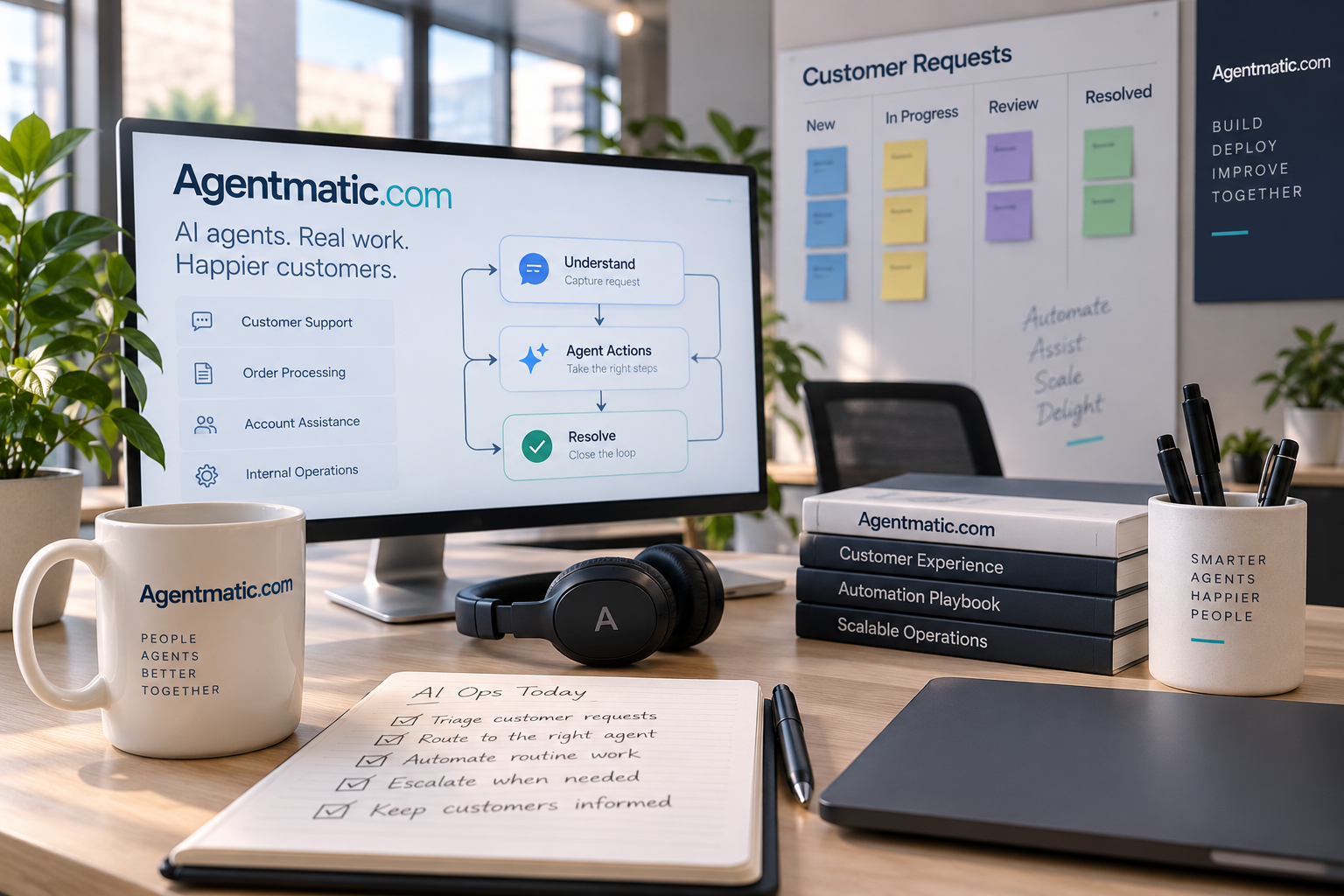
An internal AI program can become difficult to navigate before it becomes technically complicated. Employees may not know where to request help, report an unexpected result, or find the person responsible for a workflow. Agentmatic.com could name a desk that makes those responsibilities visible and gives the program a consistent place to live.
This is an illustrative operating concept. It could serve an internal team or a customer-facing operations function, depending on the buyer’s organization. It does not imply an existing corporate affiliation, support commitment, or service-level agreement. The desk’s hours, scope, and staffing would need to be established by its operator.
Make the desk a route to an accountable person
The primary audience might be department leads who use several agent-assisted workflows but cannot easily see who maintains them. Their need is often practical: a request has stalled, an answer seems wrong, or access needs to change. They need a route to resolution, not another broad introduction to artificial intelligence.
A desk could provide a simple request form, a searchable list of supported workflows, and a visible owner for each one. Each listing should say what the workflow does, what it may access, and when to contact a person. The information should remain useful even if the underlying technology changes.
Choose a narrow initial remit. For example, the desk could cover internal knowledge requests and draft preparation while leaving other automation programs with their existing owners. A clearly bounded service is easier to staff and easier for employees to understand. Expansion should follow actual demand and demonstrated capacity.
Organize incoming work by the decision needed
A request to add a new workflow is different from a report that an existing one produced a bad result. Give those requests separate routes. New work needs discovery and prioritization. An unexpected result needs enough context to investigate, possibly an immediate pause, and a person who can decide what to do next.
Access requests form another category. The desk should know who can approve a change and how the change is recorded. Avoid treating a conversational request as sufficient authorization to connect another system. A helpful intake form asks for the business reason and the responsible owner, then routes the decision appropriately.
A fourth category could be general guidance. Employees may need help deciding whether an agent-assisted workflow suits a task. Short examples of suitable and unsuitable requests can reduce confusion, but the guidance should reflect the organization’s real policies and capabilities. Keep a route to a person when the examples do not cover the situation.
Follow an exception all the way through
Imagine an employee receives a draft answer that cites an outdated internal procedure. The employee reports the answer through the desk, including the request and the cited source. The desk records the affected workflow, assigns an owner, and determines whether the problem is limited to one document or could affect other requests.
The workflow owner could remove the outdated source from the approved collection, prepare a corrected response, and review similar outputs. The desk then tells the employee what was changed and whether any further action is required. This example is about a possible resolution path; it makes no claim that a particular system can detect every outdated source.
The important design choice is continuity. The employee should not need to repeat the same explanation to several teams. A case record should preserve the original concern, investigation, decision, and follow-up. Internal notes and customer-visible updates may need different access rules, so decide that before collecting sensitive material.
Define escalation before promising availability
Write down what the desk can resolve directly and what it must send to another owner. A broken reference might go to a knowledge manager. An unexpected external action may require a different response. Name a backup when the primary owner is unavailable and explain what happens outside staffed hours.
The voluntary NIST AI Risk Management Framework offers a way to structure discussions about roles, context, and risk. It can support the desk’s planning, but its categories need to be translated into the organization’s own responsibilities. A framework cannot supply a staffed escalation path.
Keep permissions limited to the desk’s job. The OWASP agent security guidance is a useful reference when reviewing the tools an agent can use. Human desk operators also need appropriate access. Being responsible for coordinating a case does not automatically require access to every underlying business record.
Introduce the desk through existing team habits
The strongest early distribution path is internal. Place a link where employees already find operating guidance, introduce it in the meetings where workflow owners participate, and include it in relevant onboarding materials. The desk should be easy to find at the moment a person encounters a problem.
Start with a small group of supported workflows and review the incoming requests. Look for unclear routing, missing information, and cases that require repeated handoffs. Those observations can improve the service description and intake questions. Avoid treating raw request volume as proof of success; an increase may reflect either useful adoption or a recurring problem.
Compare this direction with a software brand
An internal desk and a commercial SaaS product place different demands on a name. The desk needs recognition within an organization and a clear relationship to existing support functions. A SaaS product needs an external buyer, a repeatable offer, and a distribution model. Agentmatic.com could serve either direction, but the initial brief should choose one.
For a desk, the public domain might introduce the program while access to working materials remains restricted. The organization would decide how that fits its identity and security policies. A concise service line such as “Requests and support for agent-assisted work” could explain the purpose without implying unattended operation.
To discuss this use of Agentmatic.com, include whether the desk would be internal or customer-facing, who would operate it, and which workflows it would cover. A purchase inquiry can proceed through a preferred GoDaddy or Escrow.com path. A partnership proposal should be specific about staffing, decision rights, and the contribution expected from each participant.